Governance
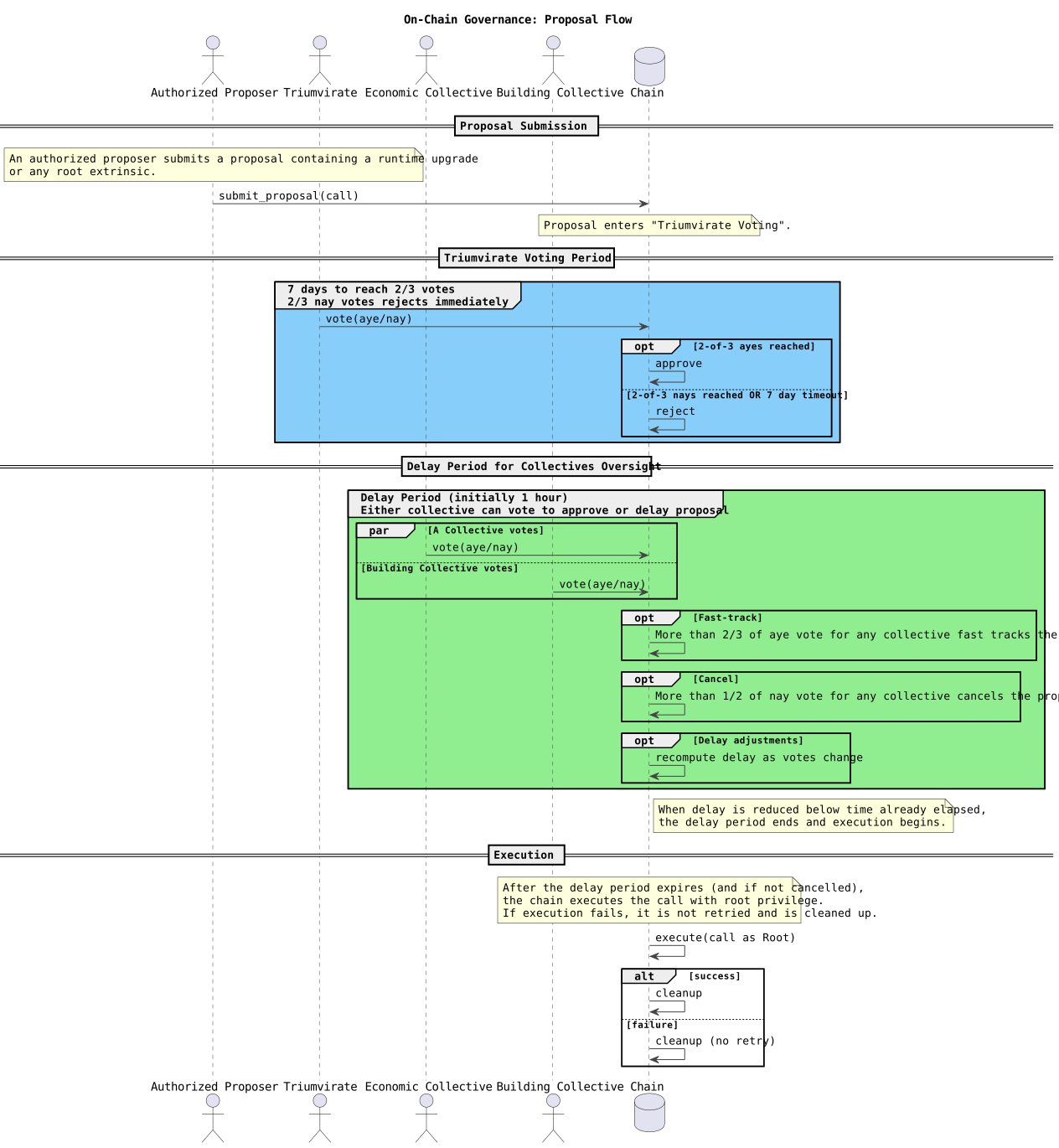
Bittensor on-chain governance, live as of June 24th, 2026, replaces sudo-based operational control with a two-stage referendum system. All root calls — protocol changes, runtime upgrades, and other privileged operations — reach the chain only after passing through both stages.
Collectives
Governance is organized around five named on-chain collectives managed by pallet-multi-collective:
| Collective | Size | Selection | Role |
|---|---|---|---|
| Proposers | 1–20 | Curated (root-assigned) | Submit proposals |
| Triumvirate | 3 (fixed) | Curated (root-assigned) | First-stage approval |
| Economic | 16 (fixed) | Rotating every 60 days | Review-stage voting |
| Building | 16 (fixed) | Rotating every 60 days | Review-stage voting |
| EconomicEligible | ≤64 | Auto-synced from root registrations | Candidate pool for Economic |
Proposal Flow
Stage 1: Triumvirate track
A member of the Proposers collective submits a root call. The proposal enters the Triumvirate track:
- The three Triumvirate members have 7 days to vote.
- 2-of-3 aye votes: proposal advances to the review track.
- 2-of-3 nay votes or timeout: proposal is rejected and cleaned up.
Stage 2: Review track
On Triumvirate approval, the proposal enters a delay period. The voter set is the deduplicated union of the Economic and Building collectives (at most 32 members). The voter set is snapshotted at the moment the review period opens — collective rotations during the delay do not change who may vote or shift the thresholds.
The delay starts at 24 hours and can extend to a 2-day maximum as nay votes accumulate, following an ease-out adjustment curve. When the adjusted delay drops below the time already elapsed, execution begins.
During the delay period, voters may:
- Fast-track: 75% or more aye votes → executes at the next block.
- Cancel: 51% or more nay votes → proposal cancelled and cleaned up.
- Otherwise the proposal executes when the delay period expires.
Execution
The chain dispatches the call with root privilege through an atomic enact wrapper. If the call fails it is not retried and is cleaned up. A stale scheduler entry on a terminated referendum cannot dispatch its inner call.
Collective Membership
Proposers and Triumvirate
Both are curated: members are added, removed, or swapped by root governance. The Triumvirate is fixed at 3 seats. Previously the Triumvirate held sudo access directly; under the new system it is the first stage of the referendum process with no direct sudo.
Economic collective
The Economic collective is selected from the EconomicEligible pool every 60 days. The top 16 EconomicEligible coldkeys by stake EMA value take the seats. If fewer than 16 eligible coldkeys are available, the rotation fails safely and the previous membership remains in place.
EconomicEligible membership is auto-synced with root registration state. When a coldkey's root-registered hotkey count goes from 0 to 1, the coldkey is added to EconomicEligible. The EMA tracks a combined stake value per coldkey: liquid TAO plus the TAO value of alpha across all owned hotkeys, sampled incrementally each block (8 subnets and ≤256 hotkeys per tick, decay factor alpha=0.02). A 210-sample warmup of approximately 30 days is required before a coldkey becomes eligible for selection.
Building collective
The Building collective is selected every 60 days. The top 16 subnet-owner coldkeys by their best subnet's moving price take the seats, subject to:
- Subnets younger than 180 days are excluded.
- At most one seat per coldkey regardless of how many qualifying subnets they own.
If fewer than 16 eligible coldkeys are available, the rotation fails safely and the previous membership remains in place.